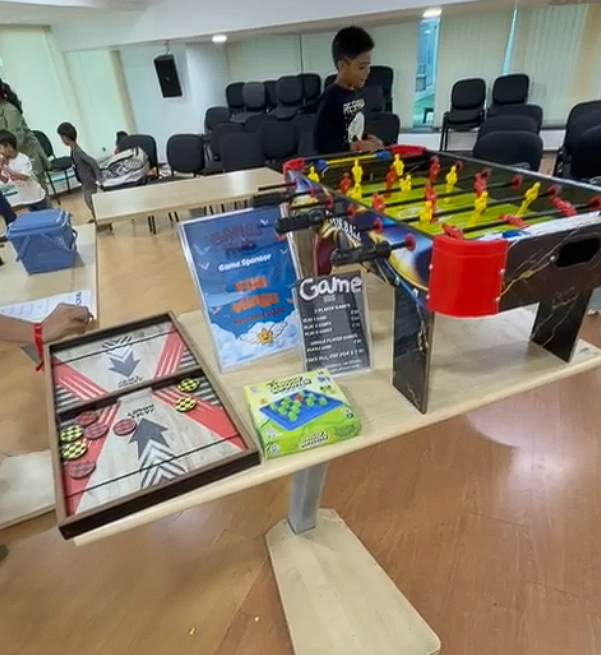
A true personal story A personal anecdote of lived experience in our Home-Ed journey. I chose Home-Ed for my children, even when my entire family stood against it. Not because it is easy, but because I believed learning is natural, voluntary and must be experienced. Marketplace has been a long-lost dream for many in the Home-Ed community. With rejuvenated exuberance in 2026, I embarked on this idea to bring it to life. My plan for Marketplace is a 2-part series to give the children of Chennai Homeschooler’s community, as early as 10+yrs, an opportunity to experience Business trade and gain Financial awareness -- an opportunity most of us could not experience. A hands-on experience of Trading goods or service in a market, Engagement and interaction with a children author specialised in Finance. The event turned out to be an excellent platform to understand various aspects of Business, Finance and Collaboration. This will remain a deep memory of experience not just for Ray but every child that held a stall at Marketplace. With a strong conviction that “happy people are happy learners”, I wanted this to be an engaging event for everyone involved. Every small detail on my blueprint of “Marketplace” plan was thoughtfully crafted and planned to the finest detail. It was my brain-child, and what it became went far beyond my plan. Read on to know why! A true story and quite an interesting experience through Marketplace! Ray is kinesthetic. He is not someone who could sit down to create something. Hence, we first chose “enabling” as our business model. We ideated on DIY Art using Handkerchiefs. We worked through everything - materials, costing, and even a dry-run of the stall. The numbers didn’t add up. Cost price itself came to approximately ₹50. Who would buy a handkerchief for ₹60, even with a marginal profit of ₹10/piece!? It did not make sense. It was not practical. It wasn't viable for both the buyer or seller. Step 1 - Ideation and effort failed. Lesson 1 - An entrepreneur is bound to fail, only to rise again. Then we went on to considering options for our next plan. What followed was far more valuable than success. As home-ed learners, learning in unconventional ways becomes a norm. “Lightbulb moment” in Ideation - The ability to identify business potential from the available resources and understanding the distribution of demography is a true skill that can only be experienced. That’s when we arrived at the idea of a Gaming Hub. And suddenly, a whole new world opened up. We had discussions, negotiations, planning, costing, collaborating, and most importantly, decision-making. In hindsight, what surprised me was the way he dealt with unexpected scenarios that weren’t originally factored in planning. Lesson: Self-awareness is a crucial tool to work around business plots to align with personal ethics. We explored and brainstormed ideas based on Ray’s strengths and limitations. IMO, in any business, smartness/talent alone doesn't always lead to success, knowing one’s own weakness does. We decided to rent a few games from FunWings, Raji’s enterprise. Instead, she suggested something better – a profit-sharing collaboration – a far more favourable arrangement than I proposed. Bingo!! An introduction to a new business model was thus born!! He learned that business need not always be product-based. Renting would mean a fixed cost and possible loss. But the concept of profit sharing meant risk and rewards were shared. What can one expect of Teenpreneur?! Ray wasn’t convinced! We started brainstorming ways to reduce the percentage. And that’s where another lesson emerged: Business involves negotiations. While money is involved, nurturing relationships is important!! But, how do I pass this ethic to a child? What followed surprised me. Ray proposed promoting FunWings as his Game Sponsor at Marketplace in exchange for a better profit share % while being fair to both parties. (Not sure if it did any justice to the Marketing with the display board at his Game Hub stall… It was this.) A child thinking in terms of value exchange, branding, and negotiation. While this gave an opportunity to understand how to think and propose a marketing advantage for Funwings at Marketplace, Raji graciously entertained Ray in this negotiation by giving him the space to explore, negotiate, and learn. It became a win-win. Then came the unexpected. On the event day of Marketplace, the circuit wiring in one of the main game boards was broken. This was not part of the plan. Not budgeted. Not anticipated. Ray was stuck and confused. When there was so much going on in my own head about a punctual start of the event, supporting the registration desk, while one of our member’s family was in distress, I didn’t have the bandwidth to lose it with Ray nor help him sort out his mishap. He took charge of the situation by himself. He reached out to Keshav from Repair Café. “Fix it - Pay it - Dust it.” Problem solved. Another collaboration. Another real-world lesson. When I discovered this part of the story later at bedtime, I was filled with pride and amusement at how the 2 teen boys helped each other and sorted the problem at hand. And that’s when it struck me again. How do we teach adaptability? Resilience? Problem-solving? Not through advice, and definitely not through coaching or textbooks. In the AI era, children learn these most essential life skills only through real-life experiences. It can only be nurtured by letting children process their problems themselves. For a child to navigate the world on their own, small situations like these quietly build Critical thinking Collaboration Decision-making Responsibility As I observe children, I am constantly in awe. They are naturally capable of self-management, until we interfere. They are natural problem-solvers, until we provide easy answers or advised to give up. They are critical thinkers, until we replace effort with convenience. You may wonder, how much did Raji earn from this model? I would say it barely covers a decent lunch at a mid-range hotel. But what I see is far more. I see a kind mother and co-parent who chose to support a child’s learning over profit, giving space, and someone who trusted the process. They say, “It takes a village to raise a child”. For someone like me, we need many villages. To me, Marketplace would never be just any ordinary event or an entertainment meetup or recognition. It was about raising aware, capable, self-reliant little humans – through trust, experience, meaningful engagement, and the courage to let them figure things out.