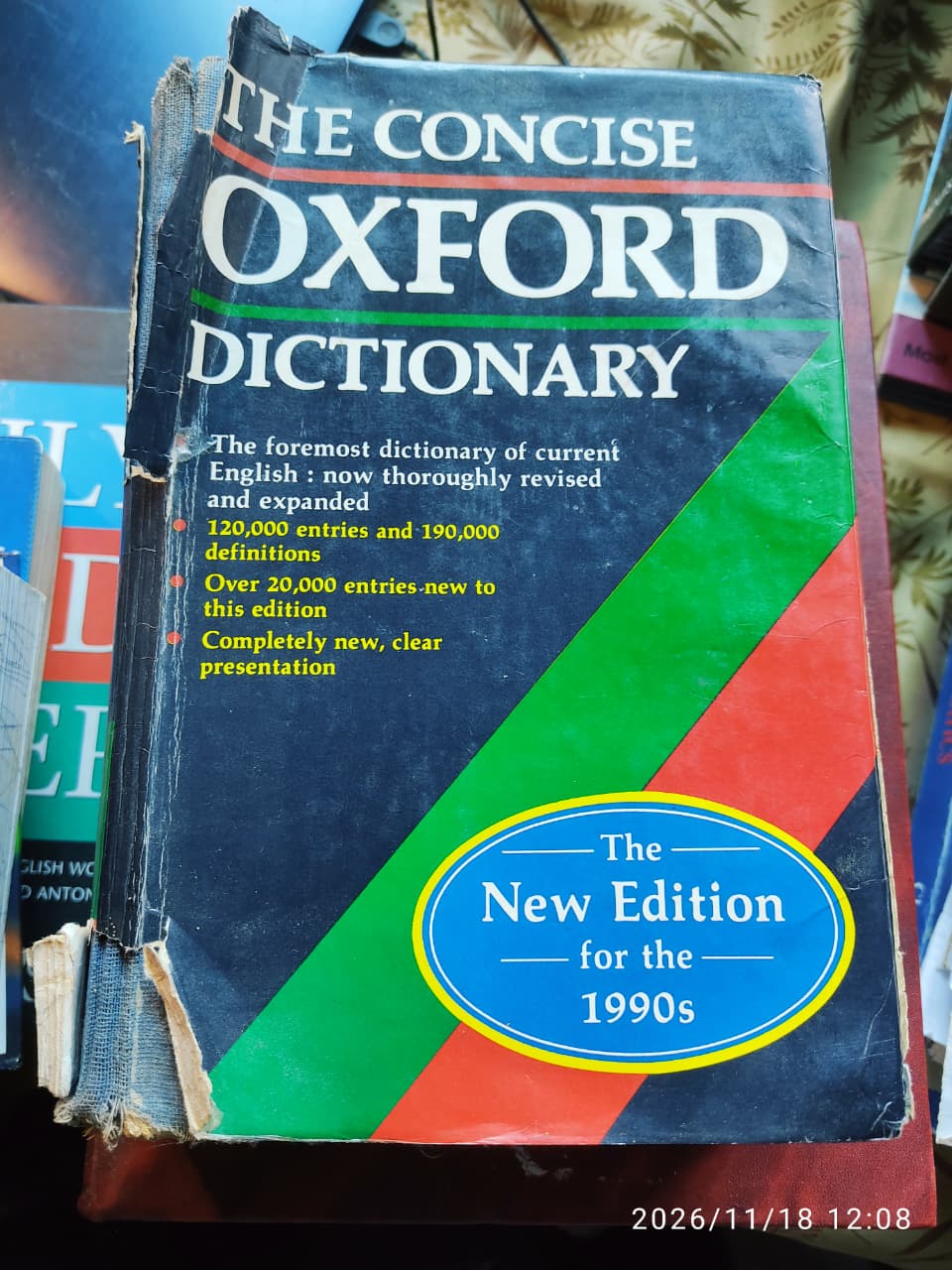
Some things are hard to give up! With time, they become obsolete, yet they remain personal treasures! One of my fondest memories of my teenage years was going on a spiral trail of hunting words in a dictionary, my best time-pass activity. I could spend hours lost in that self-invented #game. As destiny would have it, it was probably laying the foundation to who I am today and what I do. As a child, Words intrigued me! I was fascinated by their origins and derivatives and the patterns connecting them. I would form my own hypotheses about how words evolved, often discovering interesting associations between them. The phonetic symbols in the brackets were no #rocketscience, just a splash of curiosity would suffice for anyone to decode. The theories and thesis formed in my little mind, which current-day folks call it Overthinking, was indeed a technique, #Mnemonics, that came naturally and helped me remember and use them while speaking. I was oblivious to how my face twisted for getting the sounds right or to remember spellings. No one was amused or made a fuss about my inquisitive attempts at playing with words. I simply existed and did my own thing. Looking back, as children, we were inquisitive and creative inherently. Slowly, technology crept in, changed how we learn and pass time, and the rest is history. Fast forward decades, I hardly see anyone using a dictionary whatsoever. Even with the access of an electronic dictionary apps at fingertips. And yet, I hear the same question from every single student, “I want to improve my #vocabulary and #pronunciation. Help me!” Schools account for a #Dictionary in Grade 3, along with other textbooks. But how often are children encouraged to explore them? Or incorporated as a play activity? Every household has an average of at least 2 dictionaries. Families with avid readers, like mine, have at least a dozen different varieties. Diving into a Dictionary is a lost art in #languagebuilding. Instead of memorizing words, it can be made into an adventure activity: - Secret decoding games; observing patterns & connections;- #Treasurehunt with words; #Synonym detective; Experimenting #phonetic sounds;- #Homophones, #homographs, and #homonyms etc. A good facilitator can easily instill the love of language by creating an environment through play activities. With one word/phrase a day, by the time a child finishes school, anyone could be a walking Dictionary, but more importantly, it develops a lifelong curiosity and affinity for words. #communicationskills#BusinessEnglish#professionalgrowth#corporatetraining#primaryeducation#Leadership#coaching#presentationskills#englishtraining